
What Is Les Traîtres?
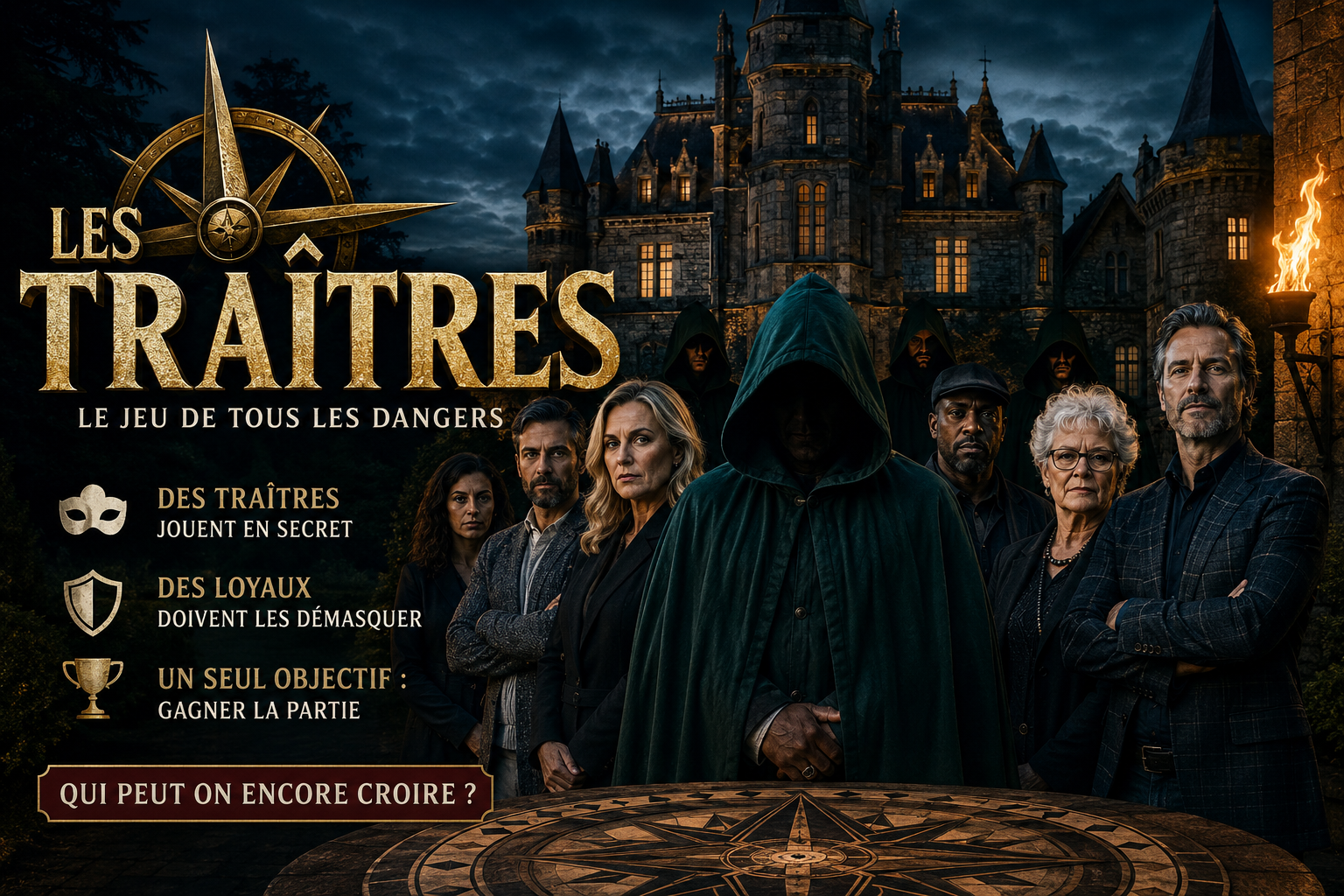
Les Traîtres is a strategic reality competition where participants live together and compete for a prize fund. The central twist is that a small number of contestants are secretly chosen as traitors.
While loyal contestants attempt to identify and eliminate the traitors, the traitors secretly work to remove loyal players from the game without revealing their identities.
The programme combines:
- Social strategy
- Psychological gameplay
- Group challenges
- Investigation and deduction
- Secret alliances
- Suspenseful eliminations
Every conversation, decision, and vote can significantly affect the outcome of the game.
The Origins of the Format
The concept behind Les Traîtres is based on the internationally successful format known as The Traitors, which itself was inspired by social deduction games such as:
- Mafia
- Werewolf
- Secret Hitler
- Among Us
These games revolve around hidden identities and strategic deception. The television adaptation successfully transforms these concepts into a dramatic and highly entertaining viewing experience.
As the format expanded internationally, local versions gained popularity in multiple countries, attracting large audiences and generating widespread discussion online.
How Does Les Traîtres Work?
At the beginning of the competition, contestants arrive at a shared location, often a castle or luxurious estate.
A host secretly selects a small number of players to become traitors.
The remaining contestants become loyal players.
The Goal of the Traitors
The traitors must:
- Remain undiscovered
- Manipulate group decisions
- Eliminate loyal players
- Reach the final stage of the game
The Goal of the Loyal Players
The loyal players must:
- Identify the traitors
- Remove them through voting
- Protect the prize fund
- Reach the finale without being eliminated
The tension comes from the fact that nobody knows for certain who the traitors are.
Understanding the Main Roles
Traitors
Traitors have a significant advantage because they know each other’s identities.
Their responsibilities include:
- Deceiving the group
- Building trust
- Influencing votes
- Eliminating loyal players
Successful traitors often display strong communication and persuasion skills.
Loyal Players
Loyal contestants possess no secret information.
Instead, they must rely on:
- Observation
- Behaviour analysis
- Group discussions
- Logical reasoning
Their challenge is considerably more difficult because they must uncover hidden identities without clear evidence.
Key Rules of Les Traîtres
Although specific details may vary between seasons, several fundamental rules remain consistent.
1. Secret Identity Selection
Traitors are selected privately and their identities remain hidden.
2. Daily Missions
Contestants participate in challenges that help increase the prize fund.
3. Round Table Discussions
Players gather to discuss suspicions and analyse behaviour.
4. Voting Process
At the end of discussions, participants vote to eliminate a suspected traitor.
5. Night Elimination
After voting concludes, traitors secretly choose a loyal player to eliminate.
6. Endgame Decisions
The final stage requires contestants to determine whether any traitors remain.
Daily Gameplay Structure
A typical episode follows a structured format.
Morning Phase
Players discover who was eliminated overnight.
This often creates shock, confusion, and new suspicions.
Mission Phase
Contestants work together in team challenges.
These challenges:
- Increase prize money
- Build relationships
- Reveal behavioural clues
Interestingly, even traitors benefit from completing missions because they share the same prize fund.
Discussion Phase
Players openly debate potential traitors.
This stage often includes:
- Accusations
- Defences
- Strategic conversations
- Alliance building
Round Table
Contestants vote for the person they believe is a traitor.
The eliminated player reveals whether they were loyal or a traitor.
Night Phase
The remaining traitors secretly select another contestant for elimination.
The cycle then repeats.
Why Are the Rules So Effective?
The rules create a unique balance between cooperation and competition.
Contestants must:
- Work together during challenges
- Distrust each other during discussions
- Build alliances
- Remain cautious at all times
This combination creates constant tension and uncertainty.
Unlike many reality programmes where objectives are obvious, Les Traîtres requires players to manage relationships and perceptions simultaneously.
Strategy and Psychological Elements
One reason Les Traîtres stands out is its psychological complexity.
Reading Behaviour
Players constantly analyse:
- Facial expressions
- Body language
- Speech patterns
- Emotional reactions
However, appearances can be misleading.
Building Trust
Trust is the most valuable currency in the game.
Contestants who appear trustworthy often gain influence over group decisions.
Managing Suspicion
Traitors must avoid attracting attention while still guiding the game in their favour.
This delicate balance requires exceptional social skills.
Creating Alliances
Strong alliances can:
- Protect contestants
- Influence voting outcomes
- Increase survival chances
Yet alliances can quickly collapse when suspicion arises.
What Makes a Successful Traitor?
The most effective traitors typically possess several qualities.
Excellent Communication Skills
They can explain decisions confidently and convincingly.
Emotional Control
Remaining calm under pressure is essential.
Adaptability
Circumstances change rapidly throughout the competition.
Strategic Thinking
Successful traitors plan several moves ahead while reacting to unexpected developments.
What Makes a Successful Loyal Player?
Loyal contestants also need specific strengths.
Observation Skills
Careful attention to behaviour can reveal valuable clues.
Critical Thinking
Players must evaluate evidence logically rather than emotionally.
Social Awareness
Understanding group dynamics is essential.
Confidence
Speaking up during discussions can influence voting outcomes.
Why Is Les Traîtres So Popular?
Several factors contribute to the show’s success.
Unpredictable Outcomes
Viewers rarely know what will happen next.
Psychological Drama
The human behaviour element creates compelling television.
Relatable Themes
Trust, loyalty, deception, and teamwork are universal concepts.
Audience Participation
Viewers often enjoy forming their own theories about potential traitors.
Strong Emotional Moments
Eliminations and revelations generate genuine reactions that keep audiences engaged.
Les Traîtres vs Other Reality Competition Shows
| Feature | Les Traîtres | Traditional Reality Shows |
|---|---|---|
| Hidden Identities | Yes | Rarely |
| Strategic Deception | Core Element | Limited |
| Group Challenges | Yes | Yes |
| Psychological Gameplay | Very High | Moderate |
| Voting Eliminations | Yes | Often |
| Mystery and Suspense | Central Focus | Secondary |
This comparison highlights why Les Traîtres offers a unique viewing experience.
Tips for Succeeding in Les Traîtres
If you were a contestant, these strategies could improve your chances.
For Loyal Players
- Avoid making assumptions too quickly.
- Pay attention to behavioural changes.
- Keep detailed mental notes.
- Listen more than you speak.
- Build trusted relationships carefully.
For Traitors
- Blend into the group.
- Avoid over-controlling discussions.
- Support group objectives.
- Maintain consistency.
- Adapt to changing situations.
What Can Viewers Learn from Les Traîtres?
Beyond entertainment, the programme offers insights into:
- Human psychology
- Communication techniques
- Leadership skills
- Group dynamics
- Decision-making under pressure
Many viewers find themselves reflecting on how trust and perception influence everyday life.
Conclusion
Les Traîtres has become one of the most fascinating reality competition formats thanks to its combination of strategy, suspense, and psychological gameplay. By placing trust and deception at the centre of the experience, the show creates a unique environment where every conversation matters and every decision carries consequences.
Whether contestants are loyal players searching for hidden traitors or traitors attempting to remain undetected, success depends on observation, communication, and strategic thinking. The blend of mystery, social deduction, and emotional drama explains why the programme continues to attract viewers around the world.
For anyone interested in understanding the concept, rules, and gameplay mechanics, Les Traîtres offers a compelling example of how simple ideas can create deeply engaging entertainment.